
What pool water does to turf, and what nobody can honestly promise you
Start with the question everyone opens with: does chlorine eat it, and does a salt chlorinator make things worse. Splash-out is not occasional here. A pool surround receives treated water constantly through summer, dripped off swimmers, thrown by kids, blown across the deck by a nor'easter, and in a salt chlorinated pool that water carries dissolved salt as well as sanitiser.
Here is where we will be more careful than most pages on this subject. Australian suppliers commonly describe landscape turf as suitable for pool surrounds and often as chlorine resistant. That may be perfectly true. What we could not find, and we went looking, is independent Australian testing that establishes how repeated chlorinated or salt water contact affects yarn and backing over a decade of use. The related question of long term salt exposure on the coast has the same hole in it. A page that responds to that absence by repeating a supplier's reassurance in its own voice is doing you no favours at all.
So treat it as a question to put to a named product rather than to the category. Ask for that product's data sheet. Then ask the sharper version, which is about the warranty rather than the brochure: is exposure to pool chemicals listed as an exclusion. Australian warranties commonly sit in the eight to fifteen year band and typically address UV fade and fibre loss rather than every possible cause of deterioration, with exclusions that differ between manufacturers. Getting that in writing before you buy costs nothing and tells you far more than a marketing line does.
One material choice is worth raising while you are on the phone. An Australian trade guide recommends polyurethane backing over latex in humid conditions, on the grounds that it absorbs less moisture and holds its shape and heat resistance better, and describes latex as ageing more rapidly in hot humid environments. That is one credible source rather than a whole industry speaking, so weigh it as such, but a surround that is wet most afternoons for four months of the year is precisely the environment the observation is about.
A surface that gets wet on a schedule, not on the weather's schedule
Every drainage discussion about artificial grass assumes rain. A pool surround breaks that assumption. It gets soaked whenever the pool is used, which in a Sydney summer means most days, often at the hottest and stillest part of the afternoon when nothing is going to help it dry. That single difference is why a surround needs a stricter answer on water than a lawn does, and why the drainage design is genuinely the whole job.
The turf itself is the easy part. Backing is perforated so water passes straight through, and the Australian baseline specification sits around 30 litres per square metre per hour. You will see suppliers advertising figures many multiples of that, which are their own claims to substantiate rather than an industry norm, and in any case a higher number through the sheet solves nothing if the water has nowhere to go once it is underneath. The real question is what happens in the next two metres.
So work out, on paper, where the water ends up before anyone quotes. It should fall away from the coping, not towards it, and it should keep travelling to something that actually removes it: a strip drain, a grate, a garden bed with somewhere to soak, or the open edge of the paving. Two destinations to rule out early are the wall of the house and a low corner boxed in by the pool fence and a retaining wall, because both turn into water sitting in one place under a surface that hides it.
When that goes wrong beside a pool, it goes wrong in a specific and unpleasant way. Trapped moisture under the backing, in a spot that is shaded for much of the day and topped up by swimmers every afternoon, is the classic recipe for a musty smell, slime and staining that will not brush out. It is not a fault in the grass. It is a fault in the surface beneath it, and it will be diagnosed as a turf problem for months before anyone lifts an edge. A surround also needs rinsing more often than an ordinary lawn does for the same reason, which is covered properly in our guide to cleaning artificial grass in Sydney rather than repeated here.
What is underneath: slab, pavers, or a compacted base against the coping
Pool surrounds are rarely plain soil, and what is already there changes the method more than the postcode does. Three situations cover most Sydney backyards, and it is common to meet two of them on the same job, because a concrete apron often runs into a lawn area a couple of metres out.
A concrete apron. Nothing is pegged into a slab, and drilling and plugging around a pool is neither quick nor tidy. Turf is bonded instead: adhesive around the full perimeter and along every join, usually over a foam underlay of around 5mm, which softens a surface that is otherwise as hard underfoot as the concrete it is sitting on and stops trowel marks reading through. Existing expansion joints keep moving after the turf covers them, so they get planned around rather than glued across.
Pavers. Same fixing method, one extra test. Walk the surround and rock a few pavers with your foot. Firm pavers with untidy joints are fine to lay over. Pavers that tip or have settled will carry on moving under the turf and you will feel every lip through it barefoot, which around a pool is the whole point of the surface. Loose units get relaid and sunken sections screeded before anything else happens.
A prepared base against the coping. Where the surround is soil or old lawn, it becomes a conventional build: excavate to roughly 75mm, lay and compact a road base, screed, compact again, and peg the perimeter at 30 to 40cm intervals. The pool specific part is the edge nearest the water, where pegs are not an option because coping is sealed, so the turf is bonded to the coping edge and pegged everywhere else. That mixed restraint detail is worth having named in the quote, and this is also the case where the barrier question later on this page becomes live, because you are changing ground levels.
The financial consequence of which case you are in is large. Base preparation accounts for roughly 30 per cent of a typical Australian install, so an existing sound apron removes most of that, and a surround that needs a drain cut in or a screed to correct its fall puts it back. Published Australian supplier pricing puts general residential work at about $85–140 per square metre installed. Those are indicative budgeting figures from published Australian supplier and industry data, and the tier by tier version is in our breakdown of what turf costs per square metre in Sydney.
The coping edge and the wet foot zone
If a pool surround job fails visibly, it fails at the coping. That edge is the busiest and wettest strip on the site, crossed by every swimmer, dripped on constantly, and viewed from inside the house all summer. It is also the hardest cut on the job, because pool shells are rarely straight. Following a curve, a bullnose or a radius corner is patient work with frequent fresh blades, not one confident run of the knife, and the difference between a neat termination and a wandering one is entirely in how much time someone was prepared to spend there.
Two rules follow from that. Keep joins away from the waterline where you can, because a seam within arm's reach of the coping is both the most inspected and the most stressed part of the installation, and put full width sheet along that edge instead. And bond that perimeter properly rather than relying on the weight of the sheet, because a lifting edge beside a pool is a trip hazard on a wet surface rather than a cosmetic complaint.
The other pool specific detail is fibres. Trimming synthetic grass sheds short offcuts, and a body of water a metre away collects everything the wind moves. Loose fibres in a skimmer basket are a real nuisance and, in volume, are not something a filtration system should be asked to deal with. The remedy is unglamorous: vacuum or sweep offcuts up properly at handover rather than brushing them towards the edge, work the sand dressing in instead of leaving it loose, and check the skimmer a few times over the first fortnight. It is a reasonable thing to raise before booking, and how an installer answers it tells you something. If you want the full sequence a professional job runs through, we set it out in our page on artificial grass installation in Sydney.
Barefoot in January: heat, grip and the hosing question
Barefoot use is the entire point of a pool surround, so heat is not a side issue here the way it might be on a lawn nobody stands on at two in the afternoon. Be clear eyed about it. Artificial grass runs hotter than living grass, and it can get very hot in full summer sun. Western Sydney University researcher Dr Sebastian Pfautsch has reported very high surface temperatures on unshaded artificial turf, and a pool surround stacks the conditions: a slab or paved base absorbing sun since morning and re-radiating it, an open aspect with nothing overhead, and light coming back up off the water.
What helps is not exciting. Shade is the strongest lever available and the only one that works without a hose, whether that is an umbrella, a sail, a pergola over part of the deck or simply keeping the barefoot crossing to a shorter run. Lighter coloured yarn runs cooler than dark green, which is plain physics rather than a sales pitch. Manufacturers including TigerTurf also point to wetting the surface before use. Where a supplier attaches a specific percentage cooler figure to a cooling yarn or an evaporative infill, that number belongs to them: ask for the testing behind it before paying a premium, and read how hot artificial grass gets for what the evidence does and does not establish.
On hosing, be accurate rather than casual, because Sydney's rules are permanent and enforceable. Sydney Water's water wise guidelines restrict watering lawns and gardens with drinking water to before 10am or after 4pm, prohibit hosing down hard surfaces, and carry fines of $220 for an individual and $550 for a business. A synthetic pool surround is not plainly a lawn and not plainly a hard surface, and we are not going to invent a ruling for it, so check the position with Sydney Water rather than assume the answer you prefer. What is certain is that there is no rebate anywhere in Australia for replacing lawn with turf, from any council, utility or state government, and the water argument for synthetic is simply that it needs none, not that anyone pays you for it.
Grip deserves the same discipline. Turf with infill brushed properly into it gives more purchase than wet smooth tile, and a shorter denser pile holds up better than a long soft lawn grass that lies flat when soaked. But no mandatory Australian product standard or published slip rating for residential landscape turf has been identified, so treat any certified sounding figure as something to trace back to a test, and treat a well drained surround as the actual safety measure. The general principles behind choosing a product carry across from synthetic grass for a Sydney backyard anywhere else on the block.
The pool barrier: the check to make before a base goes in
This is the section most turf pages skip, and it is the one that can cost you the most. Swimming pools in New South Wales are subject to a barrier regime, and part of that regime concerns non-climbable zones, which are assessed relative to the ground level on each side of the barrier. The implication for a turf job is direct: building up a level, whether with a compacted sub-base, a shockpad, a drainage layer or simply new paving, has the potential to change whether a barrier that complied yesterday still complies today.
We are deliberately not publishing dimensions, gaps or clearance figures on this page. This is child safety law, the requirements are the certifier's and the council's to apply to your particular fence, and a confidently wrong number on a page like this would be worse than no number at all. What we will say plainly is what to do about it.
Confirm the current requirements through the NSW Swimming Pool Register, and put your specific plan to your local council or a swimming pool certifier before any material goes in against a fence line. Do it at the quoting stage, not once a base is compacted, because a barrier issue discovered afterwards is remedial work on top of a finished job. Ask your installer directly whether the design changes ground levels within the barrier's zones, and be wary of anyone who treats the question as paperwork. A good answer is that they have thought about it and want the certifier to confirm. There is nothing unusual about a compliant turf surround around a pool. There is a great deal unusual about finding out you no longer have a compliant fence.
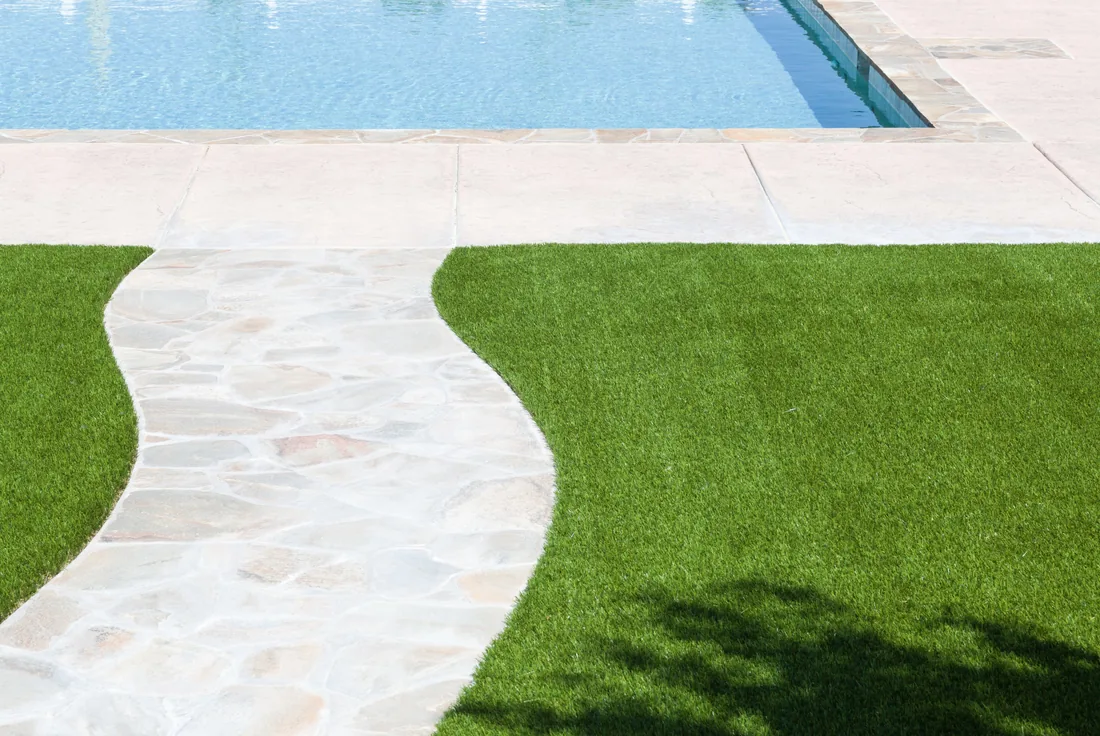
Questions Sydney pool owners ask before turfing a surround
Will chlorinated or salt water actually damage synthetic grass?
This is the question we are asked first and it is the one the industry answers least carefully. Plenty of Australian suppliers describe their landscape products as suitable beside a pool, and that may well be right, but we could not find independent Australian testing on how repeated chlorinated or salt water splash affects yarn or backing over years, and the same gap applies to coastal salt exposure generally. So the honest position is: do not take a general reassurance from a website, including this one. Ask the supplier of the specific product for their data sheet, and ask a second, sharper question about the warranty, which is whether exposure to pool chemicals is listed as an exclusion. Typical Australian warranties in the eight to fifteen year band cover UV fade and fibre loss rather than everything that can happen to a surface, and exclusions vary by manufacturer.
Where does splash-out water go once turf covers the surround?
Exactly where it went before, if the job is done properly, because the turf is not meant to change the drainage design of the surround at all. Water passes down through the perforated backing, with the Australian baseline specification sitting around 30 litres per square metre per hour, then has to travel across whatever is underneath to reach the point it always used: a grate, a strip drain, a garden bed or the open edge of the paving. Getting water through a sheet of turf is the easy half. Getting it away from the coping and out of the area is the half that decides whether the surround stays pleasant.
Do I need to check anything with a certifier or council before laying turf beside a pool?
Yes, and it is worth doing before you agree to a base build up rather than after. Swimming pools in New South Wales are subject to a barrier regime with non-climbable zone requirements, and those requirements are measured from the ground level on either side of the barrier. Anything that raises that ground level, including a compacted sub-base under new turf, has the potential to change whether a barrier still complies. We are not going to publish dimensions here, because a wrong number on a child safety topic is worse than no number. Confirm the current requirements through the NSW Swimming Pool Register and put the specific question to your council or a swimming pool certifier before work starts.
Can turf run right up to the coping, and how is it held there?
It can, and it is one of the reasons people like the look, because a soft edge against stone reads far better than a mown lawn line that never stays straight. Coping is sealed and hard, so nothing is pegged into it. The turf is bonded instead, with adhesive along that perimeter and along any join near it, and the cut has to follow the coping profile precisely, which on a curved or bullnose edge means patient trimming rather than a single straight run of the knife. Ask to see how an installer intends to finish that edge before they start, because it is the detail that gets looked at every day.
Will loose grass fibres end up in the pool or the skimmer?
Some will, especially in the first weeks after an install, and it is more of a nuisance than most people expect. Cutting synthetic turf sheds short fibre offcuts, and a pool sitting a metre away is an efficient collector of anything the wind moves. The fix is procedural rather than clever: the offcuts get vacuumed or swept up thoroughly at handover instead of being brushed towards the edge, the sand dressing is worked in properly rather than left sitting loose on the surface, and the skimmer basket is worth checking a few times over the first fortnight. After that it settles down, but an installer who tidies up casually beside a pool is creating work for the filtration system.
Is artificial grass slippery when wet next to a pool?
A turf pile with sand worked into it gives more grip underfoot than wet smooth tile, which is the usual comparison people are making, but be careful how far you take that. We have not identified a mandatory Australian product standard or a published slip resistance rating for residential landscape turf, so nobody can honestly hand you a certified figure for it, and anyone quoting one should be asked which test it comes from. What is fair to say is that a shorter, denser pile with the infill properly brushed in behaves better underfoot than a long soft lawn grass that lies flat when wet, and that a poorly drained surround holding a film of water is the condition to design out.
How hot does it get around a pool in a Sydney summer, and can I hose it down?
It gets hotter than living grass and can be very hot in full summer sun, which matters more here than almost anywhere else in a garden because a pool surround is used barefoot by definition. Western Sydney University researcher Dr Sebastian Pfautsch has reported very high surface temperatures on unshaded artificial turf, and a pool surround with a slab underneath and light bouncing off the water is not a gentle setting. Manufacturers including TigerTurf point to shade, wetting the surface before use and lighter coloured yarn as the practical levers. On hosing, be aware of Sydney Water's permanent water wise guidelines rather than assuming: watering lawns and gardens with drinking water is restricted to before 10am and after 4pm, hosing down hard surfaces is not permitted, and fines run to $220 for an individual and $550 for a business. A synthetic pool surround does not sit obviously in either category, so check with Sydney Water rather than guess, and treat shade as the lever you can rely on without a rulebook.
What sort of product suits a pool surround: pile height, infill and backing?
Australian landscape ranges generally sit between 30 and 45mm, with pet and high traffic products running shorter and denser at roughly 20 to 35mm, and the shorter, denser end of that spectrum is the one built for a surface that gets constant foot traffic. Sand dressing at the standard 10 to 15 kilograms per square metre is what keeps the blades upright and stops the pile matting, so skipping it beside a pool trades a small tidiness gain for a surface that flattens sooner. On backing, one Australian trade guide recommends polyurethane over latex for humid conditions on the basis that it absorbs less moisture and holds its dimensions and heat resistance better, while latex is described as ageing more rapidly in hot humid environments. That is a single credible source rather than a settled industry consensus, and a permanently wet surround is exactly the setting where it is worth raising with your supplier.
What should a pool surround cost, and what should the quote actually spell out?
Published Australian supplier pricing puts general residential installation at roughly $85–140 per square metre, with balcony and rooftop work at about $90–150 where access and build up are harder. A pool surround usually sits inside the residential band when the existing apron is sound and already sheds water, and above it when drainage work, a screed to correct a low point or paver relaying has to happen first. Those are indicative figures drawn from published Australian supplier and industry data for budgeting, not a quote. A quote worth signing should state how the edge at the coping is finished, what happens to the water and where it exits, whether pool barrier clearances have been checked with a certifier, the infill rate, the product's pile height and backing type, and the warranty term with its exclusions written out.
Price up turf around your pool
No cost to ask, no obligation, and nobody adds you to a sales list. Tell us roughly how big the surround is, what it is made of now, and whether the fence line is close to where the turf would go. The enquiry goes to one vetted local installer, who confirms an exact price after seeing the space. This is a quotes and information service rather than an installer or a marketplace.
Get a free, no-obligation quote
Tell us a little about your job and we'll pass it to a vetted local installer.